
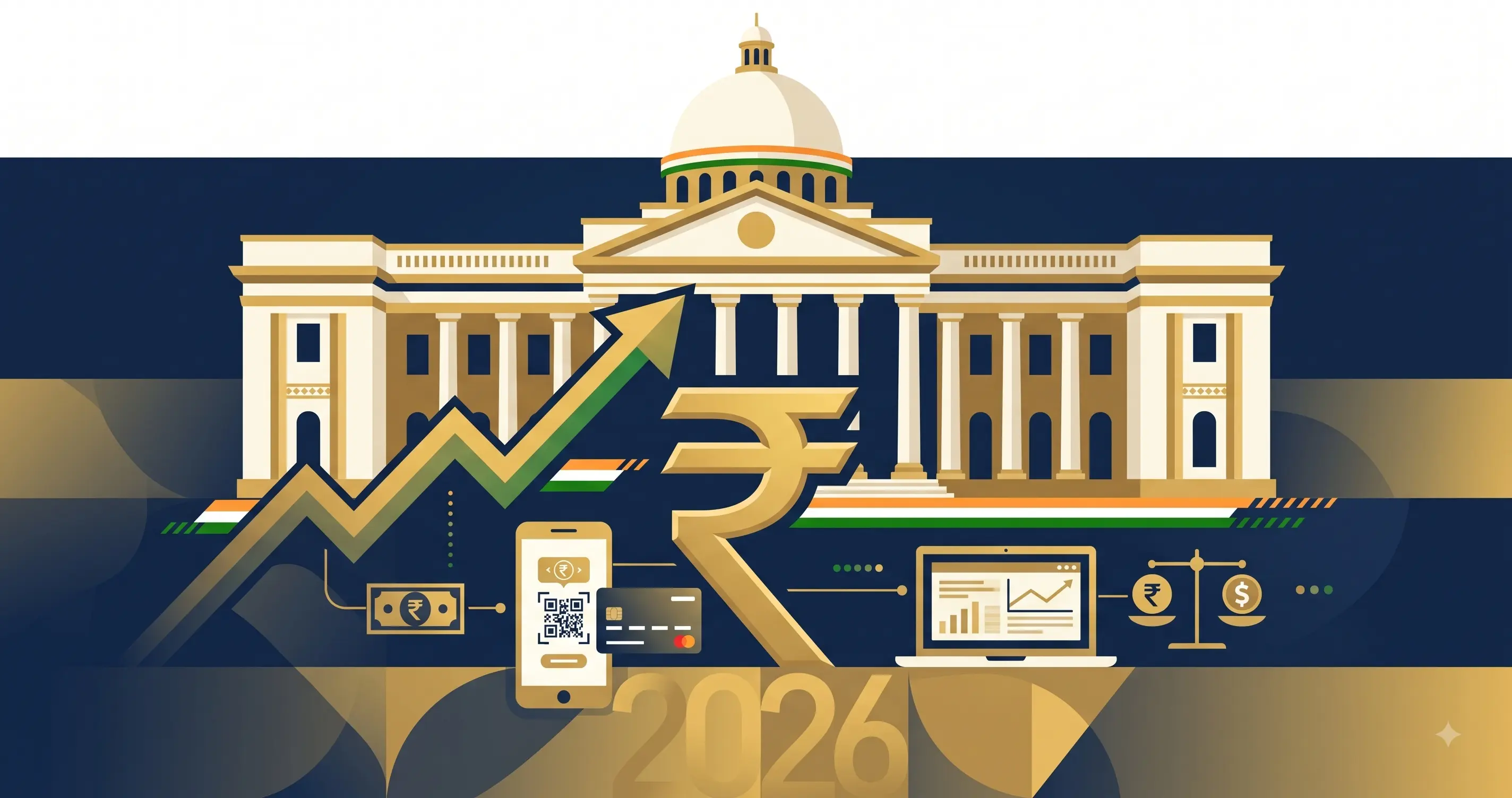
The past few days have been quite eventful for the Indian banking sector. Three major news items arrived almost simultaneously - all from different angles, and all point to the same thing: India’s banking system has emerged from crisis, is standing on solid ground, and is now looking forward. Let’s take a look at them one by one.
PSB Confluence 2026 and the Dream of a ‘Viksit Bharat 2047’
On August 17, 2026, the Department of Financial Services (DFS) of the Ministry of Finance organised a two-day event, PSB Confluence 2026, in New Delhi. It brought together top officials from the country’s public sector banks (PSBs) and public financial institutions (PFIs).
What Finance Minister Nirmala Sitharaman said is the most significant. She explained that banks’ NPAs (non-performing assets), or bad loans, are now at their lowest level ever, below 2%. Meaning? Banks have cleaned up their balance sheets, and can now move toward reform from a position of strength, not weakness. That’s the crux of the matter.
The government will soon establish a “High-Powered Committee on Banking for a Viksit Bharat.” This committee was first proposed in the February 1, 2026, budget. The results of this Confluence will be provided directly as input to this committee. Sitharaman told bankers clearly: stop making big promises and bring concrete recommendations that can actually be implemented. She reminded them that India’s goal of becoming a developed country by 2047 is less than 20 years away.
Seven themes were selected for discussion:
- Deposit mobilization
- Banking for youth
- Supporting the investment cycle
- Global Capability Centers (GCCs)
- Agriculture and horticulture value-chain infrastructure
- Priority sector lending
- New thinking in the credit card business
A key highlight was the focus on youth. The government will utilize the MY Bharat (Mera Yuva Bharat) platform, which has over 26 million registered users. The goal is to connect young people with the formal banking system and increase awareness about education loans, startups, internships, and careers. If you are just starting your banking journey, it helps to know the basics first — for example, how to find any bank’s IFSC code and branch details before opening an account or transferring money.
Simply put, this entire event is a declaration of change — banks are now adapting to the needs of the next two decades.
Airtel Payments Bank Appoints New Chairperson Shabnam Sinha
The second major news came from the corporate world. On August 17, Airtel Payments Bank announced a leadership change.
Sunil Bharti Mittal, who had been the bank’s non-executive chairman since April 2016, will step down from the position and the board on September 30, 2026. Shabnam Sinha will replace him as chairperson for a three-year term, effective October 1, 2026. This appointment has been approved by both the board and the RBI.
Now, the question: who is Shabnam Sinha? She is currently an independent director on the bank’s board. She also chairs the board’s special fraud-monitoring committee and is a member of the risk management and IT committees. This means she already has a thorough understanding of the bank’s internal affairs. She has over three decades of experience in development finance, financial services, public policy, and institutional transformation. She has also worked at the World Bank, where she advised governments across Asia, Africa, and Europe.
Consider the size of the bank — over 121 million monthly active users, nearly 30 million bank account customers, and over 500,000 banking points. This network reaches three out of four villages in the country. During Mittal’s tenure, it became India’s largest payments bank by revenue. If you bank with Airtel Payments Bank or any other lender, you can quickly lookup its IFSC code and MICR codes here whenever you need them for NEFT, RTGS, or IMPS transfers.
Analysts believe these changes mark the bank’s transition from a “startup-like mindset” to a robust, institutionalized banking company. And with such strict regulatory oversight, Sinha’s risk management experience will be the icing on the cake.
Why Did the RBI Close the FCNR(B) Swap Window Prematurely?
The third piece of news is a bit technical, but extremely important. On August 14, 2026, the RBI suddenly announced that its special dollar-rupee swap facility for FCNR(B) deposits would close on August 31, 2026 — a full month ahead of the original date (September 30).
Let’s go back a bit. This facility was announced on June 5, 2026, and began on June 8. Under this scheme, Indian banks would raise new FCNR deposits (dollar deposits from NRIs, i.e., Indians living abroad) for a period of 3 to 5 years, and then swap those dollars with the RBI at a discounted rate. This provided banks with cheaper funds, allowing them to offer better interest rates to NRI customers. A special exemption was also granted — CRR and SLR were not required on these deposits.
A look at the figures is astonishing. By August 13, a total of $56.85 billion had been received from all three channels, of which FCNR(B) alone accounted for $52.3 billion. For comparison, in 2013 a similar scheme raised approximately $34 billion in three months. This time, over 50% more than that was received in the same timeframe!
Let’s understand the timeline clearly to avoid confusion:
- Last date for raising new FCNR(B) deposits: August 31, 2026
- Banks can settle these swaps with the RBI until September 11
- The ECB and OFCB schemes will remain open until December 31, 2026, as before
This means the early closure applies only to FCNR(B) deposits, not to the other two channels.
An interesting fact: at the August 5 monetary policy press conference, RBI Governor Sanjay Malhotra clearly stated that there was no intention to close the scheme early. And yet, it was closed just nine days later! The reason? The RBI cited an “encouraging response” and the need to contain excess foreign exchange liabilities. Experts say this should be seen as a liquidity and financial-stability measure rather than a tool to strengthen the rupee.
Conclusion: Three Stories, One Direction
Look closely and all three stories form a single big picture. The PSB Confluence is preparing the roadmap for the future. A digital bank like Airtel is moving toward institutional maturity. And the RBI is managing foreign exchange flows with great prudence.
Overall, the message is clear — Indian banking has moved well past its “survival” phase. Now it’s time to move ahead with strength, inclusion, and caution, so that the dream of a developed India by 2047 can come true. And whether you are a customer, a student, or an NRI, knowing your way around the banking system starts with the basics — you can always search bank IFSC codes, branch addresses, and contact details in seconds.
Which of these three news items did you find most important? Do let us know in the comments below.